
The technology of laser cutting machines has broad development prospects and huge application space in the domestic market.
Publishing time.
Feb 03,2021
The laser cutting machine focuses the laser emitted by the laser source into a high power density laser beam through the optical path system. The laser beam irradiates the surface of the workpiece, causing the workpiece to reach its melting point or boiling point, while blowing away the high-pressure gas of the melted or vaporized metal that is coaxial with the laser beam.
The laser cutting machine focuses the laser emitted by the laser through the optical path system into a high power density laser beam. The laser beam irradiates the surface of the workpiece, causing the workpiece to reach its melting or boiling point, while blowing away the high-pressure gas of the melted or vaporized metal that is coaxial with the laser beam. The power application method of the laser cutting machine is characterized by high precision and low power application cost.
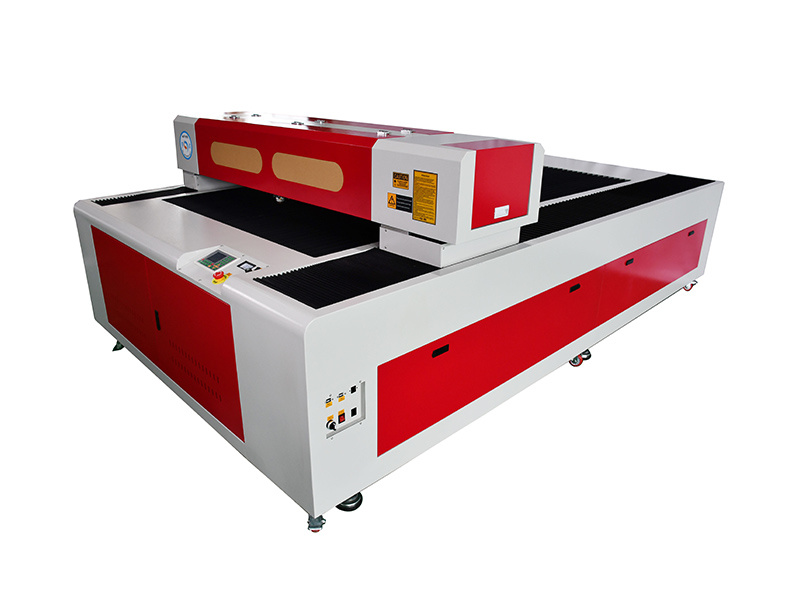
The laser cutting machine utilizes the high power density energy generated by focused laser. Under the control of a computer, the laser outputs controlled repetitive high-frequency pulsed laser through pulse discharge, forming a beam with a certain frequency and pulse width. The pulsed laser beam is transmitted and reflected through the optical path and is focused on the surface of the object through a focusing lens group, forming a fine high energy density light spot. The focus is located near the surface to be processed, instantly melting or vaporizing the processed material at high temperature. Each high-energy laser pulse will instantaneously create a small hole on the surface of the object. Under the control of a computer, the laser power application head and the processed material move continuously in relative motion and dotting according to a pre-drawn pattern, thus shaping the object into the desired form. During the cutting process of the laser cutting machine, the beam is focused into a small focal point through the lens of the cutting head, achieving high power density at the focal point, with the cutting head fixed on the Z-axis. At this time, the heat input from the beam far exceeds the portion of heat reflected, conducted, or diffused by the material, and the material is rapidly heated to melting and vaporization temperatures. Meanwhile, high-speed airflow blows away the melted and evaporated material from the coaxial or non-coaxial side, forming holes for cutting the material. As the focus moves relative to the material, the holes form a continuous narrow slit, cutting the material. Currently, the external optical path of the laser cutting machine mainly adopts a flying optical path system. The beam emitted from the laser generator passes through mirrors 1, 2, and 3 to reach the focusing lens on the cutting head, and after focusing, forms a light spot on the surface of the material to be processed. Among them, mirror 1 is fixed on the machine body; reflector 2 moves in the x direction with the movement of the beam; and mirror plate 3 on the z-axis moves in the y direction with the movement of the z-axis. During the cutting process, as the beam moves in the X direction, the Z-axis moves in the Y direction, and the length of the optical path keeps changing.
Compared with traditional cutting processes such as oxyacetylene and plasma, the laser cutting machine has advantages such as fast cutting speed, narrow cutting seam, small heat-affected zone, good perpendicularity, and smooth cutting edges. At the same time, there are many types of materials that can be cut by laser, including carbon steel, stainless steel, alloy steel, wood, plastic, rubber, cloth, ceramics, glass, and composite materials. With the rapid development of the market economy and science and technology, laser cutting technology has been widely applied in fields such as automobiles, machinery, electricity, hardware, and electrical appliances. In recent years, laser cutting technology has been developing rapidly, with an annual growth rate of 15-20%. Since 1985, China has been growing at nearly 25% annually. Currently, the overall level of laser cutting technology in China still has a significant gap compared to advanced countries, so laser cutting technology has broad development prospects and huge application space in the domestic market.
BLOGS

Why Fully Enclosed Fiber Laser Cutting Machines Are Revolutionizing Industrial Cutting
Why Fully Enclosed Fiber Laser Cutting Machines Are Revolutionizing Industrial Cutting Table of Contents Introduction to Fiber Laser Cutting Technology Benefits of Fully Enclosed Fiber Laser Cutting Machines How Fiber Laser Cutting Works Applications of Fiber Laser Cutting in Various Industries Environmental Impact of Fiber Laser Cutting Technology Choosing the Right Fully Enclosed Fi

Revolutionizing Metal Cutting: The Advantages of Fiber Laser Cutting Machines
Fiber laser cutting machines have emerged as a groundbreaking solution for cutting metal sheets, enabling industries to achieve high precision and efficiency in their operations. Utilizing a fiber laser system, these machines generate a concentrated beam of light that is capable of cutting through various types of metals, including steel, aluminum, and brass. The technology behind fiber lasers off

Why CNC Fiber Laser Cutting Machines are Essential for Modern Industries
Why CNC Fiber Laser Cutting Machines are Essential for Modern Industries Table of Contents 1. Understanding CNC Fiber Laser Cutting Technology 2. Advantages of CNC Fiber Laser Cutting Machines 2.1 Precision and Accuracy in Cutting 2.2 Enhanced Speed and Efficiency 2.3 Versatility Across Different Materials 3. Key Applications of CNC Fiber Laser Cutting Machines 3.1 Metal Fabrication and Manufactur

Understanding High Power Fiber Laser Cutting Machines: Revolutionizing Industrial Cutting Processes
High power fiber laser cutting machines represent a significant advancement in the field of industrial cutting technology. Utilizing high-intensity laser beams, these systems are capable of cutting through a variety of materials with remarkable precision and speed. This makes them an invaluable asset for industries requiring intricate and high-quality cuts, such as aerospace, automotive, and metal

The Environmental Benefits of Precision Fiber Laser Cutting Machines
The Environmental Benefits of Precision Fiber Laser Cutting Machines Introduction to Fiber Laser Cutting Technology Precision fiber laser cutting machines represent a remarkable technological advancement in the manufacturing sector. Unlike traditional cutting methods, fiber lasers utilize concentrated light energy to slice through materials with extreme precision. This innovative technology not on

Unlocking Precision and Efficiency with Plate Tube Integrated Fiber Laser Cutting Machines
In the realm of industrial equipment and components, particularly in welding and cutting machinery, the Plate Tube Integrated Fiber Laser Cutting Machine emerges as a revolutionary tool. This advanced cutting device is specifically designed to handle both plate and tube materials, making it invaluable for manufacturers seeking versatility and efficiency in their operations. One of the primary adva
Guo Zong:
+86-13963538263
+86-18663587877
Manager Feng:
+86-13869521596
E-mail:
lchrkj@163.com
Address:
Room 1045, 4th Floor, South Building, Dongdongmingzhu No.1 Auto Trade City, intersection of North Outer Ring Road and Liuyuan North Road, Dongchangfu District, Liaocheng City, Shandong Province (Yuehua Company)
Factory Address:
Phase 1, Gathering Industrial Park, Maxi Village, Hedian Town, Xin County, Liaocheng City, Shandong Province

Sales


Get the best price for your product
