
Cutting method of laser cutting machine
Publishing time.
Oct 09,2020
During laser melting cutting with a laser cutter, the workpiece is partially melted and then ejected with the help of airflow. Since the material transfer only occurs in a liquid state, this process is referred to as laser melting cutting.
The laser cutting machine partially melts the workpiece with the help of airflow during laser melting cutting, and then it is ejected. Since the material transfer only occurs in the liquid state, this process is referred to as laser melting cutting.
And the laser beam of this high-purity cutting gas can melt materials, but the gas itself does not participate in the cutting. The cutting speed of laser melting cutting is higher than that of vaporization cutting. In laser melting cutting, the laser beam is usually only partially absorbed.
The maximum cutting speed of the laser cutting machine increases with the increase of laser power, and is almost inversely proportional to the thickness of the plate and the melting temperature. When the laser power is constant, the air pressure at the slit and the thermal conductivity of the material are limiting factors. Laser melting of iron and titanium cannot achieve oxidation gaps. For steel, the laser power density is between104w/cm2and105W/cm2.
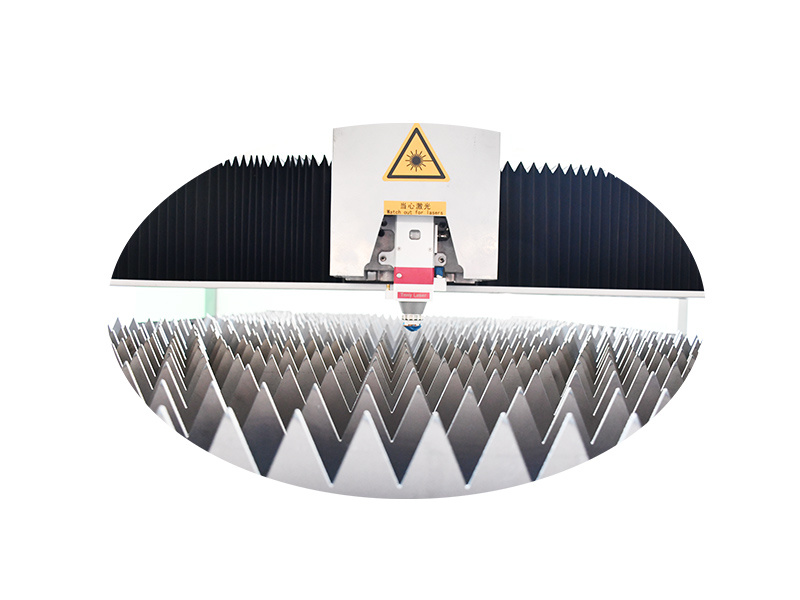
The difference between laser flame cutting and laser melting cutting is that the cutting gas is oxygen. The interaction between the heated metals produces a chemical reaction that further heats the material. Due to this effect, the cutting speed obtained using this method for structural steel of the same thickness is higher than that of melting cutting.
On the other hand, the cut of the laser cutting machine, in specific cases, may have a quality worse than that of melting cutting, producing wider slits, larger heat-affected zones, and poorer edge quality. Moreover, this laser flame cutting is not suitable for processing precision models. The power of the laser determines the cutting speed. However, the limiting factors are the oxygen supply and the thermal conductivity of the material.
In the laser vaporization cutting process, the material vaporizes at the slit, requiring very high laser power. The thickness of the material should not exceed the diameter of the laser beam. Therefore, this process is only suitable for applications where the exclusion of molten material must be avoided.
In fact, this process is only used in very small iron-based alloy fields. This process cannot be used for non-molten materials such as wood and some ceramics, and the vapor cannot condense again. In laser vaporization cutting, the focus of the beam depends on the beam quality.
The laser power of the laser cutting machine has only a certain effect on the optimal focusing position. Under the condition of a certain plate thickness and sufficient laser power, the maximum cutting speed of the laser cutting machine is limited by the gas jet speed.
BLOGS

Why Fully Enclosed Fiber Laser Cutting Machines Are Revolutionizing Industrial Cutting
Why Fully Enclosed Fiber Laser Cutting Machines Are Revolutionizing Industrial Cutting Table of Contents Introduction to Fiber Laser Cutting Technology Benefits of Fully Enclosed Fiber Laser Cutting Machines How Fiber Laser Cutting Works Applications of Fiber Laser Cutting in Various Industries Environmental Impact of Fiber Laser Cutting Technology Choosing the Right Fully Enclosed Fi

Revolutionizing Metal Cutting: The Advantages of Fiber Laser Cutting Machines
Fiber laser cutting machines have emerged as a groundbreaking solution for cutting metal sheets, enabling industries to achieve high precision and efficiency in their operations. Utilizing a fiber laser system, these machines generate a concentrated beam of light that is capable of cutting through various types of metals, including steel, aluminum, and brass. The technology behind fiber lasers off

Why CNC Fiber Laser Cutting Machines are Essential for Modern Industries
Why CNC Fiber Laser Cutting Machines are Essential for Modern Industries Table of Contents 1. Understanding CNC Fiber Laser Cutting Technology 2. Advantages of CNC Fiber Laser Cutting Machines 2.1 Precision and Accuracy in Cutting 2.2 Enhanced Speed and Efficiency 2.3 Versatility Across Different Materials 3. Key Applications of CNC Fiber Laser Cutting Machines 3.1 Metal Fabrication and Manufactur

Understanding High Power Fiber Laser Cutting Machines: Revolutionizing Industrial Cutting Processes
High power fiber laser cutting machines represent a significant advancement in the field of industrial cutting technology. Utilizing high-intensity laser beams, these systems are capable of cutting through a variety of materials with remarkable precision and speed. This makes them an invaluable asset for industries requiring intricate and high-quality cuts, such as aerospace, automotive, and metal

The Environmental Benefits of Precision Fiber Laser Cutting Machines
The Environmental Benefits of Precision Fiber Laser Cutting Machines Introduction to Fiber Laser Cutting Technology Precision fiber laser cutting machines represent a remarkable technological advancement in the manufacturing sector. Unlike traditional cutting methods, fiber lasers utilize concentrated light energy to slice through materials with extreme precision. This innovative technology not on

Unlocking Precision and Efficiency with Plate Tube Integrated Fiber Laser Cutting Machines
In the realm of industrial equipment and components, particularly in welding and cutting machinery, the Plate Tube Integrated Fiber Laser Cutting Machine emerges as a revolutionary tool. This advanced cutting device is specifically designed to handle both plate and tube materials, making it invaluable for manufacturers seeking versatility and efficiency in their operations. One of the primary adva
Guo Zong:
+86-13963538263
+86-18663587877
Manager Feng:
+86-13869521596
E-mail:
lchrkj@163.com
Address:
Room 1045, 4th Floor, South Building, Dongdongmingzhu No.1 Auto Trade City, intersection of North Outer Ring Road and Liuyuan North Road, Dongchangfu District, Liaocheng City, Shandong Province (Yuehua Company)
Factory Address:
Phase 1, Gathering Industrial Park, Maxi Village, Hedian Town, Xin County, Liaocheng City, Shandong Province

Sales


Get the best price for your product
