
The principle of laser marking machine
Publishing time.
Oct 12,2020
Since its inception in 1958, laser marking machines have gradually and firmly penetrated various fields such as scientific research, military, and industry. If you look around us, you can easily find examples of its applications: laser diagnostic and laser treatment machines in hospitals, barcode recognition devices in stores, laser marking machines in offices, fiber optics connecting us with the world, and so on. Even in our homes, there are laser water dispensers and laser record players.
Self1958Since its inception, laser marking machines have gradually and firmly penetrated various fields such as scientific research, military, and industry. If you look around us, you can easily find examples of its applications: laser diagnostic and treatment machines in hospitals, barcode recognition devices in stores, laser marking machines in offices, fiber optics connecting us with the world, and so on. Even in our homes, there are laser water dispensers and laser players.
In addition, there are many ancillary products based on the laser marking machine prototype. For example: gas lasers,CO2laser devices, solid crystal lasers (such as glass lasers), ion lasers (such as hydrogen ion lasers), dye lasers (such as phenol purple lasers), superradiant lasers (such as ammonia lasers), semiconductor lasers (such as semiconductor lasers), etc.
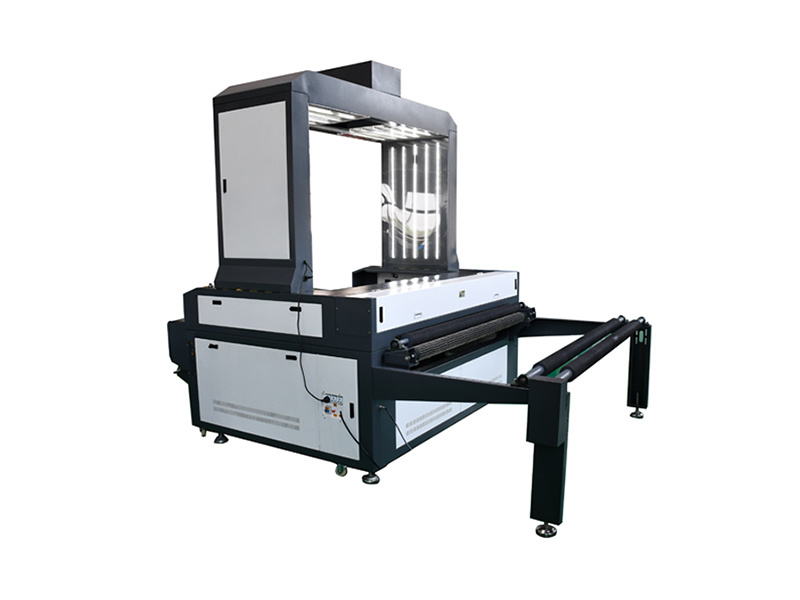
In many parts of the world, almost all laser marking machines are widely used in the manufacturing industry.CO2Laser marking machines are mainly used for various industrial laser processing equipment. As a type of solid crystal laser,Nd:YAGThe largest application of lasers is in the field of laser marking.
The working principle of laser marking machines, which is also the principle of lasers, is that matter is composed of atoms, and atoms are made up of positively charged atomic nuclei and negatively charged electrons outside the nucleus. Each electron rotates around the atomic nucleus along an orbit, and its rotation radius depends on the energy level of the electron.
After an atom absorbs energy, the rotation radius of the electron increases, and after the atom releases energy, the rotation radius of the electron decreases. Each energy level corresponds to a specific energy. Generally, the energy of electrons is discontinuous, and the energy levels of atoms are quantized.
In general, atoms can only absorb the energy difference between two energy levels, and the change of electrons between energy levels is called a transition. When an atom transitions to a lower energy level, in this case, the energy difference between the two energy levels is released. This is the reason why organic matter needs to release energy for the laser marking machine.
Atoms can absorb photons to gain energy. This is why laser marking machines need to be charged. Of course, the energy level of this photon must match the energy level difference of the atom. Normal electric charge can meet this requirement. Atoms can only absorb photons of a few specific energies. Coincidentally, electric energy is one of them, and the energy of a photon depends on its wavelength. Therefore, only photons of certain specific wavelengths can be absorbed.
Under normal circumstances, after an atom absorbs energy, it stays at the upper energy level for a period of time, then emits a photon in any direction and returns to the ground state. This is the principle of laser marking machines.
BLOGS

Why Fully Enclosed Fiber Laser Cutting Machines Are Revolutionizing Industrial Cutting
Why Fully Enclosed Fiber Laser Cutting Machines Are Revolutionizing Industrial Cutting Table of Contents Introduction to Fiber Laser Cutting Technology Benefits of Fully Enclosed Fiber Laser Cutting Machines How Fiber Laser Cutting Works Applications of Fiber Laser Cutting in Various Industries Environmental Impact of Fiber Laser Cutting Technology Choosing the Right Fully Enclosed Fi

Revolutionizing Metal Cutting: The Advantages of Fiber Laser Cutting Machines
Fiber laser cutting machines have emerged as a groundbreaking solution for cutting metal sheets, enabling industries to achieve high precision and efficiency in their operations. Utilizing a fiber laser system, these machines generate a concentrated beam of light that is capable of cutting through various types of metals, including steel, aluminum, and brass. The technology behind fiber lasers off

Why CNC Fiber Laser Cutting Machines are Essential for Modern Industries
Why CNC Fiber Laser Cutting Machines are Essential for Modern Industries Table of Contents 1. Understanding CNC Fiber Laser Cutting Technology 2. Advantages of CNC Fiber Laser Cutting Machines 2.1 Precision and Accuracy in Cutting 2.2 Enhanced Speed and Efficiency 2.3 Versatility Across Different Materials 3. Key Applications of CNC Fiber Laser Cutting Machines 3.1 Metal Fabrication and Manufactur

Understanding High Power Fiber Laser Cutting Machines: Revolutionizing Industrial Cutting Processes
High power fiber laser cutting machines represent a significant advancement in the field of industrial cutting technology. Utilizing high-intensity laser beams, these systems are capable of cutting through a variety of materials with remarkable precision and speed. This makes them an invaluable asset for industries requiring intricate and high-quality cuts, such as aerospace, automotive, and metal

The Environmental Benefits of Precision Fiber Laser Cutting Machines
The Environmental Benefits of Precision Fiber Laser Cutting Machines Introduction to Fiber Laser Cutting Technology Precision fiber laser cutting machines represent a remarkable technological advancement in the manufacturing sector. Unlike traditional cutting methods, fiber lasers utilize concentrated light energy to slice through materials with extreme precision. This innovative technology not on

Unlocking Precision and Efficiency with Plate Tube Integrated Fiber Laser Cutting Machines
In the realm of industrial equipment and components, particularly in welding and cutting machinery, the Plate Tube Integrated Fiber Laser Cutting Machine emerges as a revolutionary tool. This advanced cutting device is specifically designed to handle both plate and tube materials, making it invaluable for manufacturers seeking versatility and efficiency in their operations. One of the primary adva
Guo Zong:
+86-13963538263
+86-18663587877
Manager Feng:
+86-13869521596
E-mail:
lchrkj@163.com
Address:
Room 1045, 4th Floor, South Building, Dongdongmingzhu No.1 Auto Trade City, intersection of North Outer Ring Road and Liuyuan North Road, Dongchangfu District, Liaocheng City, Shandong Province (Yuehua Company)
Factory Address:
Phase 1, Gathering Industrial Park, Maxi Village, Hedian Town, Xin County, Liaocheng City, Shandong Province

Sales


Get the best price for your product
